The Best Shoe Display Stand Solution for Organizing More Products in Small Retail Stores
The global footwear market was valued at USD 495.46 billion in 2025 and is projected to surge from USD 529.25 billion in 2026 to USD 912.13 billion by 2034, growing at a CAGR of 7.04% (Fortune Business Insights). Within this market, the sandals and slippers segment alone reached USD 63.17 billion in 2025, expanding to an estimated USD 66.03 billion in 2026 (Mordor Intelligence). In the United States, the shoe stores industry is already a $67.5 billion market in 2026 (IBISWorld), with physical retail still accounting for approximately two-thirds of all footwear revenue by value.
Yet despite this enormous commercial opportunity, the single most common complaint among small and independent shoe retailers is a problem that has nothing to do with inventory quality or pricing: floor space. The average independent shoe store operates in 50 to 150 square meters. Displaying a full range of slippers, sandals, and casual footwear across multiple colorways and size options — without the store feeling cramped, cluttered, and impossible to navigate — requires a fundamentally different display strategy than a flat shelf or a generic gondola unit.
The answer, used by leading independent shoe boutiques and footwear brand distributors across the US, UK, Europe, and Australia, is a professional shoe display rack system engineered around vertical density, product-specific hanging architecture, and mobile flexibility.
This article explains exactly how to choose the right Slippers Display Rack for a small retail environment — and why the right footwear display rack is the highest-ROI fixture investment a small shoe store owner can make.
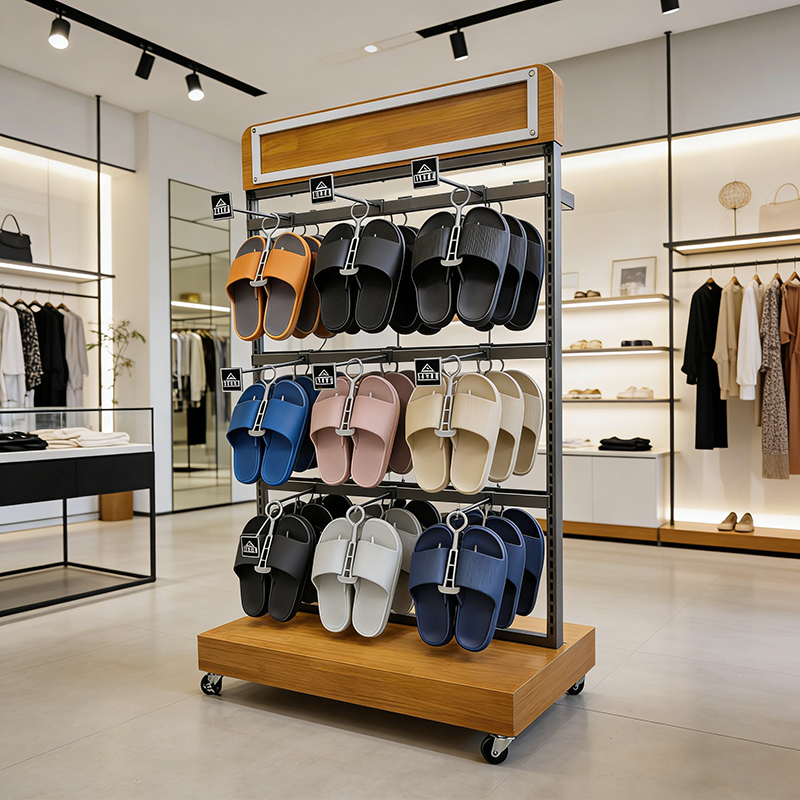
The Small Store Space Crisis — Why Traditional Shoe Shelving Fails
Walk into any independently operated shoe store operating in under 100 square meters, and you will encounter the same problem: rows of flat shelves displaying one shoe per size, eating up wall space and floor area with agonizing inefficiency.
Traditional shoe shelving operates on a "one pair per shelf position" logic — each pair of shoes laid flat, toe forward, one beside the other. For a store carrying a slippers range in four colors and six sizes, this format requires 24 individual shelf positions for a single style alone. Multiply that across a range of ten slipper styles and the math becomes impossible: 240 shelf positions for slippers alone, consuming an entire wall.
The result is a familiar retail failure mode: stores that carry only a fraction of their available range on the floor, hide the rest in backroom stock, miss sales because customers cannot see the full size and color offering, and create a chaotic browsing environment that drives customers toward the exit rather than toward the checkout.
A professional Slippers Shoe Display Stand designed around a vertical hanging system solves this problem at the structural level — not by rearranging the problem, but by eliminating it.
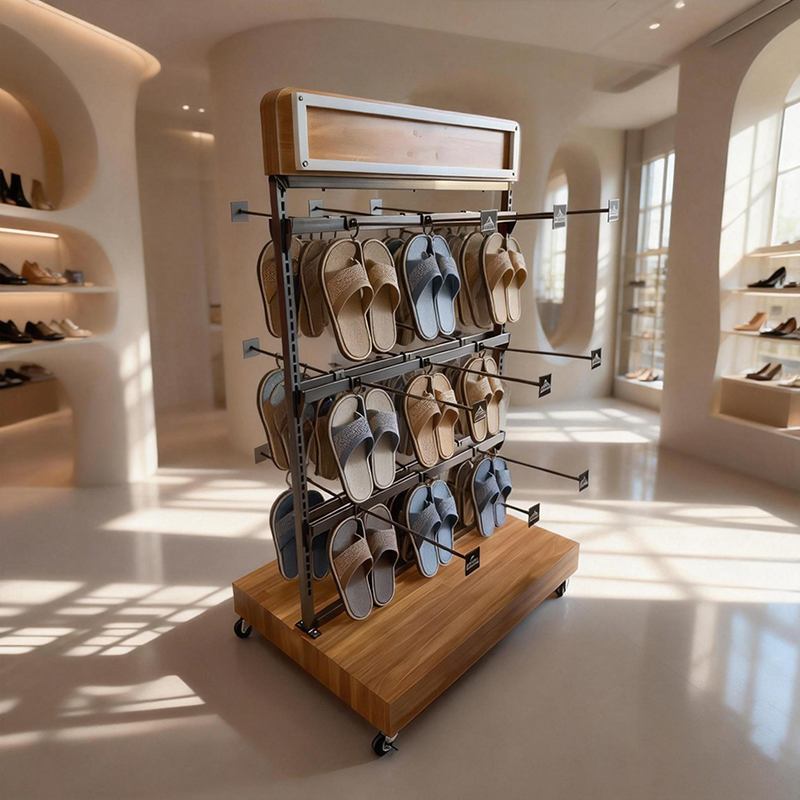
The Hanging Architecture — How a Slippers Display Rack Reclaims Your Floor
The product featured in this article demonstrates exactly why a hanging shoe display rack outperforms flat shelving in a small retail environment.
Vertical Product Suspension: Three Tiers, One Footprint
Our featured Slippers Display Rack presents slippers in a three-level vertical hanging configuration using specialist slipper-specific display clamps. Each clamp holds a pair of slippers by the sole edge, suspending them vertically so:
● The full silhouette of each slipper style is visible from the customer's natural standing perspective.
● Both the top surface and the sole design are partially visible simultaneously — important for fashion slippers where sole texture and strap design are key purchase triggers.
● Pairs are presented as complete units rather than individual shoes, eliminating the customer frustration of searching for matching pairs across separate shelf positions.
On a single footwear display rack of this format, a store can display 9 individual slipper styles or colorways across three tiers — each with a fully visible, perfectly presented pair — in a floor footprint of approximately 65 × 55 cm. That same 9-style display on traditional flat shelving would require roughly 180 cm of linear shelf width.
The Wood Base Platform: Dual Function Display
The warm-toned natural wood platform base of our shoe store display serves a dual commercial function:
Product zone : The platform surface can display 3–4 additional pairs as a "hero" or promotional spotlight — the newest arrival, the seasonal best-seller, or a clearance offer.
Mobility base : The platform houses four industrial-grade 360-degree casters, making the entire Slippers Shoe Display Stand fully mobile. Store managers can reposition the unit to the entrance during peak traffic, move it to the sales counter for impulse purchase activation, or clear it from the floor entirely for store events — in under a minute, without tools or additional staff.
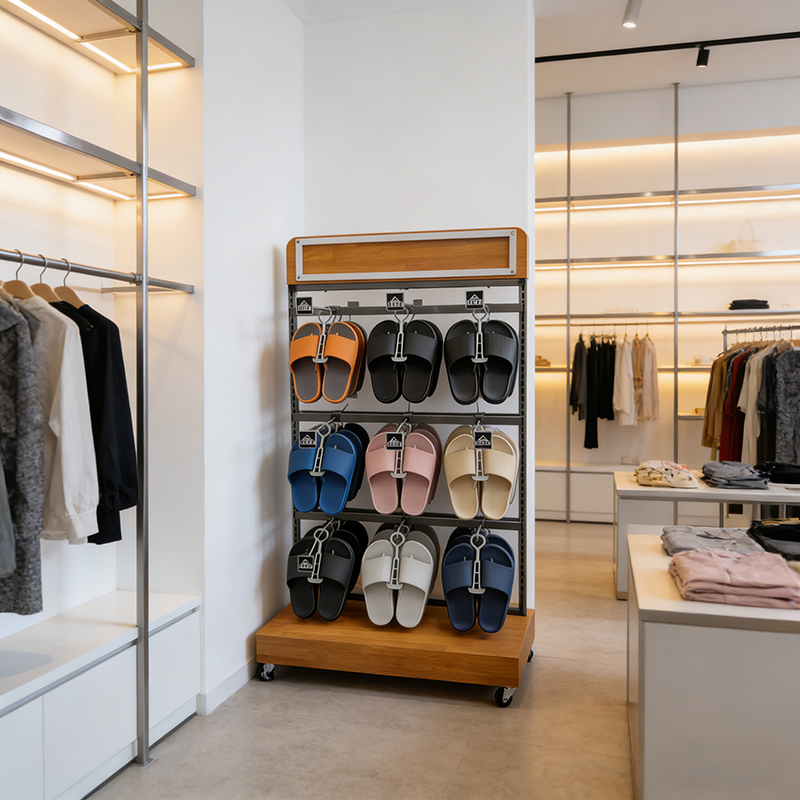
Why the Metal-and-Wood Combination Defines Premium Footwear Retail
The material palette of our featured footwear display rack — industrial grey powder-coated steel frame, natural wood grain header and platform — is the dominant aesthetic of premium independent shoe retail in 2026.
Steel Frame: Structural Performance
The powder-coated steel uprights and crossbars of the shoe display rack carry the full product load without flex or deformation. For a fully loaded Slippers Shoe Display Stand holding 12 pairs of rubber-soled slippers plus a decorated base platform, the combined product weight can reach 8–12 kg. Our welded steel frame is rated for significantly higher loads, ensuring the fixture remains perfectly upright and stable at all stock levels.
Wood Elements: Commercial Warmth
Raw steel alone — without the wood header and base — reads as industrial in a footwear retail environment. The addition of warm-toned wood grain provides the visual warmth that makes customers want to slow down, touch, and engage with the products on display. Footwear purchasing is a tactile, emotional experience. The material environment of your shoe store display must invite that emotional engagement, not repel it.
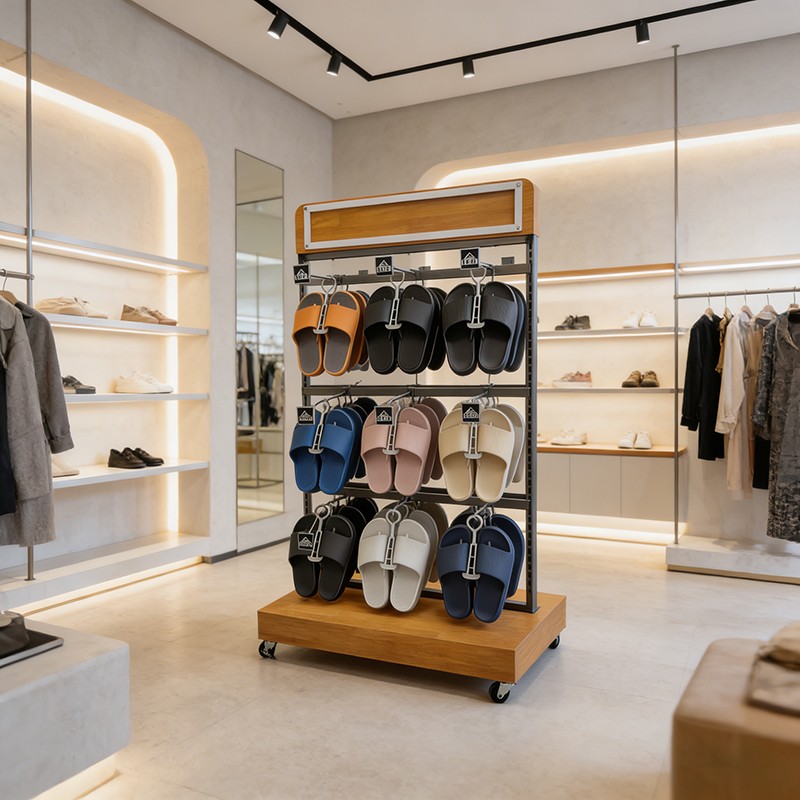
SKU Density Comparison — The Retail Math Behind a Slippers Display Rack
To make the commercial case concrete for small shoe store owners and footwear brand procurement managers, here is a direct comparison between traditional flat shelving and our hanging Slippers Display Rack:
Metric | Traditional Flat Shelving | Hanging Slippers Display Rack |
Floor footprint | 120 × 40 cm (single unit) | 65 × 55 cm |
Pairs displayed per unit | 6–8 pairs (flat, toe-forward) | 12 pairs (3-tier hang + base platform) |
Colorways visible simultaneously | 6–8 | 12 |
Mobility | Static | Fully mobile (360° casters) |
Branding capability | Shelf edge label strip only | Full-height branded header (interchangeable) |
Assembly | Fixed installation | KD flat-pack, tool-free, under 15 min |
Restock ease | Moderate — pair matching required | High — hanging clamps give instant pair visibility |
The conclusion is clear: a professional shoe display rack delivers more product visibility, more SKU density, more brand impact, and more operational flexibility in a smaller floor footprint than any flat shelf alternative.
FAQ
Q: Can the hanging clamps on the Slippers Shoe Display Stand accommodate different slipper sole thicknesses?
A: Yes. Our slipper-specific display clamps are spring-tensioned with a grip range of 10–35mm sole thickness, accommodating everything from ultra-thin EVA flat slippers to thick-soled chunky slides. The clamp jaw is lined with soft rubber to prevent any marking of the sole surface.
Q: Is the shoe display rack suitable for heavier footwear like sandals with leather straps or platform soles?
A: Our footwear display rack hanging rail and clamp system is rated for pairs up to 1.2 kg each. For platform or heeled sandals, we recommend placing these on the wood base platform rather than the hanging rails, using the hanging tiers for lighter flat slippers and slides.
Q: What is the MOQ for a custom shoe store display with our brand's logo on the header?
A: For a custom shoe store display with brand-specific header printing, custom RAL powder coat color on the steel frame, and custom wood tone on the platform, our MOQ starts at 20 units. Sample units of 1–2 are available for showroom evaluation before committing to bulk production.
Q: How does the footwear display rack ship internationally, and how long does assembly take?
A: All footwear display rack units ship in KD (Knock-Down) flat-pack format, reducing shipping volume by approximately 55–60% versus fully assembled units. On-site assembly by one person takes under 15 minutes using the included hardware kit. Ocean freight lead time to US and EU ports is 20–35 days from production completion.
A professional Slippers Display Rack built around vertical hanging architecture, a mobile base, and a branded header is not a luxury for large chain retailers — it is the most practical, highest-ROI floor fixture available to any independent shoe store owner.
It doubles your on-floor SKU capacity. It makes every pair you carry visible, accessible, and presented at its best. And it moves wherever the customers are.
Contact Arri Displays today for factory-direct pricing on a custom shoe display rack program. We provide OEM/ODM footwear display solutions for independent boutiques, chain retailers, and brand distributors across the US, EU, UK, and Australia.