What Should Buyers Consider When Choosing a Tile Display Rack for Commercial Showrooms?
What Should Buyers Consider When Choosing a Tile Display Rack?
Tile display rack selection plays a critical role in how tile products are presented, evaluated, and purchased in professional showroom environments. For tile retailers and building material showrooms, the right display system directly affects customer experience, product comparison efficiency, and sales conversion.
Unlike lightweight retail products, tiles are heavy, rigid, and visually dependent on surface texture and pattern continuity. A poorly designed display rack can limit customer interaction, reduce perceived product quality, and even create safety risks. This is why buyers must approach tile display rack selection with a clear understanding of commercial requirements.
The Evolution of Tile Display Systems in Retail
As the construction and interior design industries evolved, tile merchandising moved from static wall displays to more interactive systems. Early fixed racks limited the number of samples shown and made it difficult for customers to compare options.
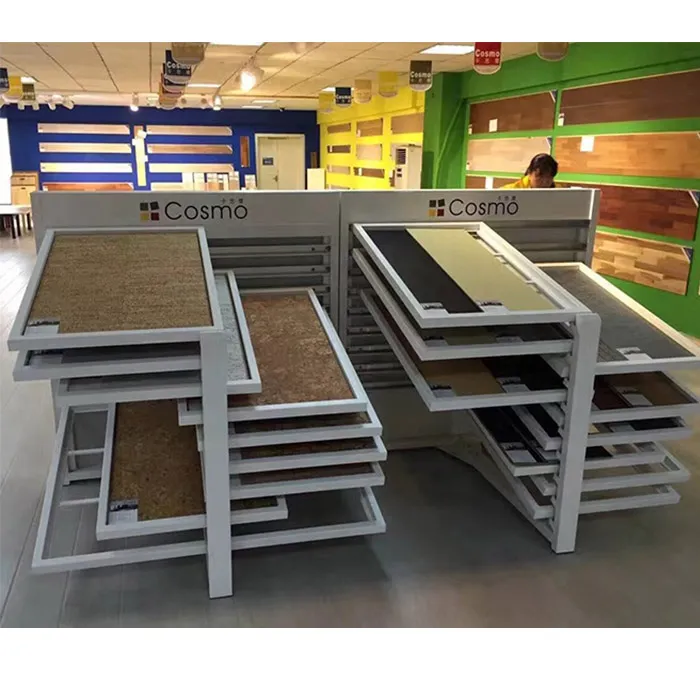
Modern showrooms increasingly adopt sliding and rotating systems, particularly industrial sliding tile rack designs, which allow multiple tile panels to be displayed vertically while remaining easy to browse. This shift reflects changing buyer behavior, where customers expect hands-on interaction and efficient comparison before making purchasing decisions.
Product Overview and Structural Design
A professional tile display rack is engineered to support heavy loads while maintaining smooth operation and long-term durability. Most commercial-grade racks are manufactured from reinforced metal structures designed specifically for showroom use.
Core Structural Elements
| Component | Commercial Benefit |
|---|---|
| Heavy-duty metal frame | Supports large-format tile samples |
| Sliding panel system | Enables easy product comparison |
| Reinforced base | Improves stability and safety |
| Industrial-grade tracks | Ensures smooth long-term operation |
| Modular configuration | Allows future expansion |
A metal tile display rack is particularly suited for high-traffic tile showrooms where durability and reliability are essential.
Material Selection and Load-Bearing Capacity
Tiles are significantly heavier than many other retail products, making material selection a top priority. Steel and reinforced metal alloys are commonly used to ensure structural integrity.
A high-quality tile display rack should:
Support repeated sliding without deformation
Maintain alignment under full load
Resist wear from frequent customer handling
Perform reliably in long-term commercial use
This is especially important for large-format tiles commonly used in flooring and wall applications.
Usability and Customer Interaction
From a buyer’s perspective, ease of use directly affects sales performance. Customers need to view full tile surfaces, compare finishes, and slide panels without assistance.
An industrial sliding tile rack improves usability by:
Allowing one-person operation
Displaying multiple SKUs in a compact footprint
Reducing physical strain on staff
Encouraging longer customer engagement
These factors contribute to a more professional and customer-friendly showroom environment.
Applications in Tile and Building Material Showrooms
Among ArriTec’s target customer groups, building material stores and tile showrooms are the most suitable match for this product category. This includes both large chain showrooms and independent tile retailers.
Common application scenarios include:
Ceramic and porcelain tile showrooms
Flooring and wall material retailers
Architectural material display centers
Wholesale tile distributors
A well-designed tile display rack supports both retail browsing and professional buyer consultations.
Supplier Capability and OEM Customization
Choosing the right tile display rack supplier is just as important as selecting the rack itself. Commercial buyers often require customization to fit showroom layouts, tile sizes, or brand identity.
OEM services may include:
Custom rack dimensions
Adjustable panel spacing
Brand-specific finishes
Layout planning support
MOQ is flexible, allowing buyers to scale orders according to project size without rigid quantity constraints.
Quality Control and Manufacturing Standards
Professional tile display racks are produced under strict manufacturing standards to ensure safety and consistency. Quality control processes focus on structural stability, smooth sliding performance, and surface finishing.
Key quality checks include:
Load-bearing stress testing
Sliding mechanism durability testing
Weld integrity inspection
Surface treatment and corrosion resistance
These measures help ensure long-term reliability in demanding commercial environments.
After-Sales Support and Long-Term Value
For B2B buyers, long-term cooperation matters. Reliable after-sales support ensures smooth reordering, expansion, or replacement as showrooms grow or update displays.
An experienced tile display rack supplier provides:
Technical consultation
OEM continuity for future orders
Stable production capacity
Responsive support communication
This reduces operational risk for showroom operators and distributors.
Frequently Asked Questions (FAQ)
Is a metal tile display rack suitable for large-format tiles?
Yes. Heavy-duty metal structures are specifically designed to support large and heavy tile samples.
Can sliding racks be customized for different showroom layouts?
Yes. OEM customization allows flexible configurations based on space and product range.
Is this suitable for both wholesale and retail environments?
Absolutely. Sliding tile racks are widely used in both retail showrooms and wholesale display centers.
Conclusion: Making the Right Investment in Tile Display
Selecting the right tile display rack is a strategic decision for tile retailers and building material showrooms. Buyers must consider structure, material strength, usability, supplier capability, and long-term reliability.
A professionally designed tile display rack not only improves product presentation but also enhances customer experience, supports sales conversations, and reflects the professionalism of the showroom itself. For B2B buyers seeking scalable, durable, and customizable solutions, industrial sliding tile display systems represent a practical and future-ready investment.